In an era where data breaches cost companies millions and cyber attacks are increasingly automated, a firewall remains the foundation of any serious security strategy.
But “what is a firewall”? It is no longer just a simple digital barrier. Today’s firewall is an intelligent gateway that controls the flow of incoming and outgoing traffic based on predetermined security rules.
This guide will walk you through everything you need to know from basic definitions and how firewalls work, to the latest trends like Next-Generation Firewalls (NGFW) and managed security services.
What is a Firewall?
A firewall is a security system that monitors and controls incoming and outgoing network traffic based on a set of predefined security rules. Its primary purpose is to establish a barrier between a trusted internal network and untrusted external networks, such as the public internet.
The definition has expanded significantly to include cloud-native firewalls and hybrid mesh platforms designed to protect distributed workforces and multi-cloud infrastructure.
How Firewalls Work: From Packet Filtering to Deep Inspection
Firewalls act as a critical junction where data is evaluated in real-time. They inspect packets, which are small units of data, and compare them against established safety benchmarks. Depending on your configuration, a firewall can filter traffic based on source, destination, or content.
Modern firewalls utilize several sophisticated methods to secure your network:
Observing Data Transfers
Security gateways operate continuously to oversee all information entering and leaving the network. Each packet is systematically evaluated against predefined safety standards.
Tracking Ongoing Connections
Advanced firewalls move beyond simple packet checks by monitoring the status of active data exchanges. This helps distinguish legitimate packets involved in a current session from those that may signal malicious activity.
Functioning as an Intermediary
In specific configurations, a firewall acts as a “go-between” for a user and the resource they are requesting.
It initiates the request on the user’s behalf, receives the response, and evaluates the content’s safety before forwarding it. This protects the network’s internal structure from outside scrutiny.
Elevated Packet Examination
Deep Packet Inspection (DPI) examines the full payload of a data packet, not just the header. This method uncovers advanced threats like malicious software or unauthorized intrusions that simpler methods might miss.
DPI is essential because over 95% of web traffic is encrypted, and attackers hide malicious code inside legitimate channels like HTTPS.
Essential Types of Firewalls
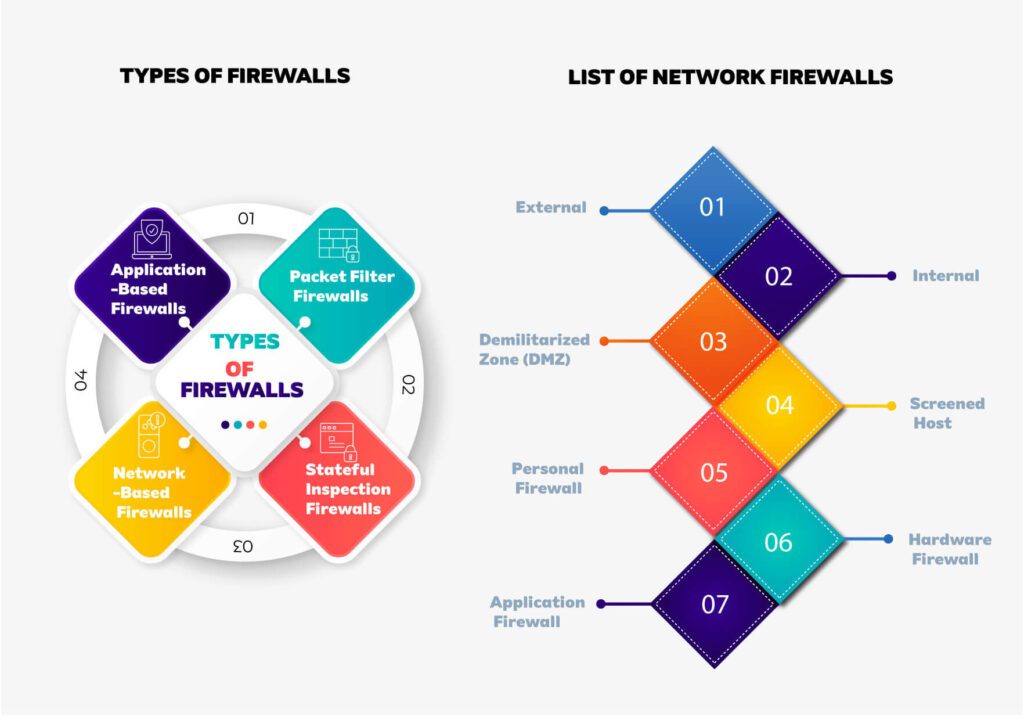
Understanding the different types of firewalls helps you choose the right protection for your needs. Here are the most common varieties used are:
Packet Filtering Firewall
This is the most basic form of firewall. It examines packets and checks the source and destination IP addresses, protocol, and port number.
This is the most basic form of firewall. It examines packets and checks the source and destination IP addresses, protocol, and port number. If a packet does not match the rule set, for example if it tries to access a blocked port, it is simply dropped.
While fast and efficient, these firewalls operate mainly on the network layer and offer limited protection against modern, sophisticated threats.
Stateful Inspection Firewall
Unlike simple packet filters, stateful firewalls track the state of active connections. They maintain a table of open connections and check whether an incoming packet is part of an established, legitimate session.
This provides a stronger layer of security, though they can still be vulnerable to Denial-of-Service (DoS) attacks that exploit trusted connections.
Proxy Firewall (Application-Level Gateway)
Proxy firewalls act as an intermediary between end-users and the web servers they visit. They prevent direct connections from outside clients, making it much harder for attackers to discover the network’s true IP address.
By inspecting the actual payload of the traffic, these firewalls can block malicious code disguised as a valid data request.
NAT Firewall
Network Address Translation (NAT) firewalls allow multiple devices with private IP addresses to connect to the internet using a single public IP address. This hides individual device IPs from potential attackers, providing an extra layer of obscurity.
Next-Generation Firewall (NGFW)
The Next-Generation Firewall is the industry standard for businesses. An NGFW combines the capabilities of a traditional stateful firewall with additional features like Deep Packet Inspection (DPI), Intrusion Prevention Systems (IPS), and application-level awareness.
The core shift with NGFW is moving from simple “port and protocol” blocking to context-aware security. While a traditional firewall checks your ticket; an NGFW checks your ticket, scans your luggage, and verifies your identity against threat intelligence feeds.
This allows it to distinguish between a user streaming video from a legitimate service versus an attacker tunneling data through a hidden channel on the same port.
Web Application Firewall (WAF)
While network firewalls protect the perimeter, a Web Application Firewall (WAF) protects web applications themselves by filtering HTTP/HTTPS traffic. WAFs defend against application-layer attacks such as SQL injection, cross-site scripting (XSS), and bot attacks.
As organizations rely more on web-based software, WAFs have become essential for compliance with standards like PCI DSS 4.0.
Why Firewalls are Essential?
The importance of a firewall extends beyond simple traffic blocking. In the current threat climate, firewalls provide critical business resilience:
Preventing Ransomware: Firewalls block the Command-and-Control (C2) communication that ransomware requires to encrypt files or receive instructions.
Regulatory Compliance: Frameworks like GDPR, PCI DSS, and Australia’s Privacy Act reforms mandate firewall protection for sensitive data. Using outdated technology may no longer be considered “reasonable steps” under the law.
Visibility: Modern firewalls provide logs that give security teams a detailed view of network activity, which is essential for forensic analysis after an incident.
Blocking “Shadow AI”: Now, “Shadow AI” is a major threat. Employees using unapproved Generative AI tools that leak company data. NGFWs can set granular policies to block uploads to unauthorized AI services while allowing approved ones.
What is a Managed Firewall?
A managed firewall refers to a service where a third-party provider (often a Managed Security Service Provider or MSSP) handles the setup, configuration, monitoring, and maintenance of your firewall.
This is distinct from an “unmanaged” setup where your internal IT team is responsible for all updates and rule changes.
Managed firewall services are growing rapidly because they solve two major problems: the shortage of skilled cybersecurity staff and the need for 24/7 monitoring.
Providers use central management consoles to deploy and configure firewalls across multiple client sites, ensuring consistent security policies.
Managed vs. Unmanaged Firewall: Explained
Choosing between managed and unmanaged services depends on your team’s expertise and resources.
Unmanaged
You purchase the hardware or software, and your staff configures and maintains it. This offers full control but requires dedicated expertise. Misconfigurations are a common risk in this model.
Managed (Service)
The service provider handles the heavy lifting. They perform audits, install patches, and respond to alerts. For many small to medium businesses, this is the most effective way to achieve enterprise-grade security without the overhead.
For Managed Service Providers (MSPs) themselves, offering managed firewalls creates a recurring revenue stream and strengthens client relationships.
Beyond Hardware: Firewall as a Service (FWaaS)
Many organizations are moving away from physical appliances to Firewall as a Service (FWaaS). As a core component of the Secure Access Service Edge (SASE) framework, FWaaS delivers next-generation firewall capabilities in the cloud.
This ensures that security follows the user, whether they are working from a home office, a coffee shop, or a corporate headquarters.
Traditional vs. Next-Gen Firewalls: A Practical View
The difference between old and new technology can be summarized by what they can “see.” A traditional firewall sees ports and IP addresses. An NGFW sees applications, users, and content.
Core Differences
Visibility: Traditional firewalls check ports and protocols. NGFWs provide full application and user visibility.
Threat Intelligence: Traditional models rely on static, manual updates. NGFWs use real-time AI cloud feeds to update against threats that evolve in minutes.
Access Model: Old firewalls operate on a “perimeter-based” model (inside the network is safe). NGFWs integrate with Zero Trust principles, assuming every device and user could be compromised.
Identity: Traditional firewalls are IP-address based. NGFWs are identity-aware, differentiating between a real employee and an AI-generated deepfake bot.
Performance Tradeoffs
When sizing a firewall, it is important to look beyond marketing brochures. In real-world production, enabling heavy features like TLS inspection and malware scanning can reduce throughput to 25-50% of the base headline number.
Latency may also increase for sensitive flows under deep inspection. Planning for these tradeoffs ensures that security features don’t bottleneck your office productivity.
List of Managed Firewall Security Service Providers
The firewall market includes both technology vendors who build the products and Managed Security Service Providers (MSSPs) who manage them for clients. Leading names include:
- Fortinet: A market leader known for its high-performance Next-Generation Firewalls and integrated Security Fabric platform. Their FortiGate series combines firewall, VPN, and UTM functionality with ASIC-accelerated performance.
- Palo Alto Networks: A dominant force in NGFW and SASE (Prisma SASE), heavily investing in AI-driven security to protect against modern threats like shadow AI.
- Cisco Systems: An industry giant integrating AI-powered security (Hypershield) and quantum-resistant capabilities into its extensive networking and firewall product lines.
- Check Point Software Technologies: Provides unified, AI-powered security across networks and cloud via its Infinity Platform, with advanced NGFW and IPS capabilities.
- Juniper Networks: Delivers secure access with its cloud-native JUNOSaaS platform, focusing on compliance and secure connectivity.
- SonicWall: Continues to innovate with its 8th Gen firewall devices, focusing on edge protection and built-in ZTNA for secure remote access.
- Barracuda Networks: A key player in the MSP channel, offering comprehensive network and cloud security solutions.
- Sophos: Popular among small-to-medium businesses, providing integrated firewall appliances and managed security services.
- Zscaler: A leader in Firewall as a Service (FWaaS) and the SASE market, delivering cloud-native security for modern, distributed workforces.
- WatchGuard Technologies: Focuses on network detection and response (NDR) and unified threat management for distributed environments.
- McAfee: A well-known provider of managed security services and endpoint protection, including virtual threat protection services.
- IBM: A top-tier MSSP offering comprehensive managed security services, including firewall management, 24/7 monitoring, and incident response.
Firewall Optimization and Best Practices
Simply installing a firewall is not enough. To ensure maximum performance and security, administrators should follow key best practices:
Remove Unused Rules: Over time, firewall rule bases become cluttered with obsolete rules. Removing unused rules and objects reduces complexity and the attack surface.
Place Heavily Used Rules at the Top: In most firewalls, rules are processed in order. Placing the most frequently matched rules near the top reduces processing load.
Filter Traffic Upstream: Move filtering for known bad inbound traffic to the edge router. This saves firewall CPU and memory for more complex inspection tasks.
Upgrade Software: Newer versions often contain performance enhancements and critical security patches. Running outdated firmware is a common cause of vulnerabilities.
Adopt an Allow List Approach: For critical segments, define rules that allow only specific, approved traffic (allow list) and block everything else. This is more secure than trying to list everything you want to block (block list).
Firewall Policy: Planning and Management
Your firewall is only as good as the policy that governs it. A strong policy starts with defining business intent, such as determining what finance teams should access versus engineering teams. From there, you add identity controls and threat prevention profiles.
It is crucial to treat your firewall policy like production code. This means reviewing it quarterly, removing dead rules based on hit counts, and using automated tools to manage complexity.
Monitoring is also key; configuring rules to log blocked traffic helps teams identify intrusion attempts and fine-tune controls.
Conclusion
A firewall is a non-negotiable component of modern cybersecurity. Whether you choose a simple packet filter for a home office, a Next-Generation Firewall for a corporate network, or a fully managed service to offload complexity, the important step is to ensure you have one in place.
As threats become more sophisticated, for example using AI to hide in plain sight, your defenses must evolve.
By understanding the types of firewalls available and following best practices for configuration, you can protect your organization’s data and maintain the trust of your customers.
Frequently Asked Questions
1. What is the basic difference between a hardware and software firewall?
A hardware firewall is a physical appliance that sits between your network and the internet, protecting all connected devices. A software firewall is installed on individual devices and protects only that specific device.
2. Can a firewall stop all cyber attacks?
No. Firewalls block unauthorized access and known threats, but they must be part of a broader strategy including antivirus, patching, and employee training.
3. What is the difference between a firewall and an antivirus?
A firewall controls network traffic. Antivirus scans files on your device for malware. They work together for layered defense.
4. Is a firewall still relevant with cloud computing?
Yes. Firewalls are delivered as Firewall as a Service (FWaaS) or virtual appliances to protect cloud workloads and remote connections.
5. What ports should I block on my firewall?
Common recommendations include blocking ports for SMB (445), Telnet (23), FTP (21), and RDP (3389) from untrusted sources if not actively used.