
In a world where cyberattacks are constantly increasing in frequency, severity, and sophistication, cybersecurity professionals need to start thinking about how they can combat these threats.
The field of data science is becoming more important every day as it provides new insights into the behavior of attackers and malware.
This comprehensive guide explores how data science is transforming cybersecurity, the key techniques driving this change, and what professionals need to know to stay ahead.
Is Data Science used in Cybersecurity?
Yes, data science is a foundational component of modern cybersecurity. It applies machine learning, statistical analysis, and big data processing to detect threats in real-time, predict attacks before they occur, and automate incident response.
Data science enables security teams to analyze billions of events daily, identify anomalies that human analysts would miss, and adapt defenses as threats evolve. Organizations using AI-powered security operations report 70% faster threat detection and 50% faster response times .
What Is Data Science in Cybersecurity?
Data science in cybersecurity is the discipline of using statistical analysis, machine learning algorithms, and big data processing to detect, prevent, and respond to cyber threats.
According to Carnegie Mellon’s Software Engineering Institute, this data science combines security domain expertise with advanced analytics to defend against evolving threats .
Rather than relying on predefined rules or signatures, data science enables security systems to learn from data, identify patterns, and adapt to new threats in real-time .
At its core, this approach transforms raw security data like network logs, endpoint telemetry, user behavior, and threat intelligence feeds into actionable insights.
Machine learning algorithms process this information to distinguish between normal activity and potential threats, often identifying malicious behavior that traditional rule-based systems miss entirely.
Deep learning, a subset of machine learning, uses multi-layered neural networks to process complex, unstructured data. In cybersecurity, deep learning excels at:
- Malware binary analysis: Converting executables into images for classification
- Network packet inspection: Identifying encrypted command-and-control (C2) communications
- User behavior analytics: Detecting subtle deviations from baselines
Why Traditional Security Fails Without Data Science
Traditional cybersecurity approaches—firewalls, antivirus software, and SIEM correlation rules—were designed for a different era. They face three fundamental challenges that only data science can solve:
The Scale Problem
Enterprise environments generate petabytes of log data daily. A typical Fortune 500 company processes over 50 billion security events per day. No human team can manually analyze this volume. Data science enables automated analysis at scale.
The Speed Problem
Attackers increasingly use AI to automate vulnerability scanning, phishing campaigns, and credential stuffing. According to Darktrace’s 2025 Threat Report, AI-powered attacks are 40% faster than human-led attacks. Defenders need autonomous AI to keep pace.
The Unknown Problem
Signature-based detection fails against zero-day attacks and novel malware. Data science addresses this through behavioral analytics by establishing baselines of normal activity and flagging deviations, regardless of whether the specific threat has been seen before.
| Challenge | Traditional Approach | Data Science Approach |
| High alert volume | Manual triage | ML-powered prioritization |
| Unknown threats | Signature updates | Anomaly detection |
| Slow investigation | Manual queries | AI-assisted investigation |
| Limited visibility | Siloed data sources | Unified analytics |
Traditional Security vs. Data Science-Enhanced Security
| Capability | Traditional Security | Data Science-Enhanced Security |
| Threat detection | Signature-based, known threats only | Behavioral analytics, zero-day detection |
| Alert volume | 10,000+ daily alerts per SOC | Prioritized, contextual alerts |
| Investigation time | Hours per incident | Minutes with AI assistance |
| False positive rate | 50–70% | 10–20% with tuned ML models |
| Adaptability | Manual rule updates (weeks) | Continuous model retraining (real-time) |
| Threat hunting | Manual queries by senior analysts | AI-assisted pattern discovery |
| Scalability | Limited by analyst headcount | Cloud-scale, billions of events |
Data Science vs. Machine Learning vs. AI
These terms are often used interchangeably but represent distinct concepts:
| Term | Definition | Security Context |
| Data Science | Interdisciplinary field using scientific methods to extract insights from data | Developing analytics frameworks, defining security KPIs, visualizing threat intelligence |
| Machine Learning | Subset of AI where systems learn from data without explicit programming | Anomaly detection, classification, prediction models |
| Deep Learning | Subset of ML using multi-layer neural networks | Malware binary analysis, packet inspection, NLP for threat intel |
| Artificial Intelligence | Broad field of machines performing tasks requiring human intelligence | Security automation, autonomous response, LLM-based analysis, Agentic AI |
Core Techniques: Machine Learning, Deep Learning, and AI
Supervised Learning
Supervised learning uses labeled datasets where each input is paired with a known output. The model learns to map new inputs to correct outputs based on this training.
In cybersecurity, supervised learning is used for:
- Malware classification: Identifying known malware families based on features like API calls, file structure, and execution behavior.
- Phishing detection: Analyzing email content, sender reputation, and linguistic patterns.
- Network intrusion detection: Classifying network flows as benign or malicious based on labeled training data.
- Common algorithms: Random Forest, Support Vector Machines (SVM), Gradient Boosting, Neural Networks.
Unsupervised Learning
Unsupervised learning works with unlabeled data, discovering hidden patterns and structures without pre-existing categories. This is essential for detecting novel threats.
In cybersecurity, unsupervised learning is used for:
- Anomaly detection: Identifying unusual network traffic, user behavior, or system activity.
- Insider threat detection: Finding users whose behavior deviates from their established baseline.
- Malware clustering: Grouping previously unseen malware samples by similarity.
Common algorithms: Isolation Forest, K-Means Clustering, Autoencoders, Principal Component Analysis (PCA).
Deep Learning
Deep learning uses artificial neural networks with multiple layers to process complex, unstructured data. It excels at tasks where feature engineering is difficult.
In cybersecurity, deep learning is applied to:
- Binary analysis: Converting malware executables to images and using convolutional neural networks (CNNs) for classification.
- Network traffic analysis: Recurrent neural networks (RNNs) and transformers for analyzing packet sequences.
- Natural language processing: Analyzing security reports, threat intelligence, and log messages.
Reinforcement Learning
Emerging in cybersecurity, reinforcement learning trains agents to make sequences of decisions by rewarding desired behaviors. Applications include:
- Automated incident response
- Adaptive security orchestration
- Autonomous penetration testing
Key Applications of Data Science in Cybersecurity
Threat Detection & Anomaly Identification
Modern Security Operations Centers (SOCs) use machine learning models to automatically triage alerts, group similar events, and rank risks by severity. This reduces mean time to detection (MTTD) from hours to minutes.
User and Entity Behavior Analytics (UEBA)
UEBA systems establish behavioral baselines for users, devices, and applications, then flag deviations that may indicate compromise. This is particularly effective for detecting:
- Credential compromise: Legitimate credentials used in anomalous ways.
- Lateral movement: Attackers moving across the network after initial breach.
- Insider threats: Malicious or negligent actions by authorized users.
Network Traffic Analysis
Data science models analyze network flows to identify:
- Unusual data exfiltration patterns
- Malicious domain generation algorithms (DGA)
- Encrypted tunnel detection
- Command-and-control (C2) communications
Malware Classification & Analysis
Machine learning algorithms classify malware samples by analyzing features such as:
- API call sequences
- File structure and entropy
- Execution behavior in sandbox environments
- Binary visualization (converting to images)
Phishing Detection
Natural language processing (NLP) models analyze email content, sender reputation, and linguistic patterns to identify sophisticated phishing attempts that bypass traditional filters. Modern models achieve over 99% detection rates with false positive rates below 0.1%.
Fraud Detection
Financial services and e-commerce companies use machine learning to detect:
- Account takeover attempts
- Payment fraud
- Synthetic identity creation
- Transaction anomalies
Automated Incident Response
AI-powered orchestration platforms can:
- Automatically contain compromised endpoints
- Block malicious IP addresses
- Quarantine suspicious files
- Generate incident reports for human review
Essential Skills and Learning Path
Foundational Knowledge
| Domain | Topics |
| Networking | TCP/IP, DNS, HTTP/S, network protocols |
| Operating Systems | Linux command line, Windows security, system internals |
| Security Fundamentals | MITRE ATT&CK framework, Cyber Kill Chain, OWASP Top 10 |
| Python Programming | Data structures, functions, file I/O, basic scripting |
Data Science & ML Fundamentals
| Domain | Topics |
| Data Analysis | Pandas, NumPy, data visualization (Matplotlib, Seaborn) |
| Machine Learning | Scikit-learn, supervised vs. unsupervised, model evaluation |
| Anomaly Detection | Isolation Forest, One-Class SVM, statistical methods |
| Capstone Project | Build a phishing URL classifier or network anomaly detector |
AI-Powered Security
| Domain | Topics |
| Deep Learning | Neural networks, CNNs for malware classification, RNNs for sequence analysis |
| LLM Security | Prompt engineering, model fine-tuning, secure deployment |
| Adversarial ML | Model evasion, poisoning attacks, defenses |
| Capstone Project | Deploy a real-time anomaly detection system |
Recommended Datasets for Practice
- NSL-KDD: Network intrusion detection benchmark
- CICIDS2017: Modern network traffic with realistic attacks
- UNSW-NB15: Hybrid of real modern normal and attack activities
- Ember: Endgame Malware Benchmark for static malware classification
The Cybersecurity Job Market
The demand for professionals who understand both cybersecurity and data science has exploded.
Job Growth Statistics
According to the U.S. Bureau of Labor Statistics, information security analyst roles are projected to grow 32% from 2022 to 2032, much faster than average.
LinkedIn’s 2025 Emerging Jobs Report listed “AI Security Specialist” as the fastest-growing job title.
Over 15,000 job postings for machine learning security roles exist across the U.S. as of 2026.
Common Job Titles
- Security Data Scientist
- AI Security Engineer
- Threat Intelligence Analyst (ML focus)
- SOC Automation Engineer
- Machine Learning Engineer (Security)
- Adversarial AI Researcher
Salary Ranges
| Role | Entry Level | Mid-Career | Senior |
| Security Data Scientist | $110,000–$130,000 | $140,000–$170,000 | $180,000–$220,000+ |
| AI Security Engineer | $120,000–$140,000 | $150,000–$180,000 | $190,000–$230,000+ |
| Threat Intelligence Analyst | $85,000–$105,000 | $110,000–$140,000 | $150,000–$180,000+ |
Sources: Glassdoor, Indeed, and industry salary surveys
Top Data Science Trends Shaping Cybersecurity in 2026
1. Agentic AI
Unlike standard generative AI that responds to prompts, Agentic AI acts as a digital colleague. When a threat is detected, an autonomous agent doesn’t just alert a human, it begins investigating.
It synthesizes reasoning, pulls context from multiple sources, and delivers a complete incident summary before the analyst even opens the ticket .
2. Adversarial Machine Learning
As defenders deploy AI, attackers use AI to evade it. Adversarial attacks involve subtly manipulating input data (e.g., changing a few pixels in a file) to cause AI models to misclassify malware as safe. Defenders now need skills in “AI forensics” and model hardening.
3. Large Language Models (LLMs) for Security Operations
Security teams are deploying specialized LLMs to:
- Summarize security alerts into plain English
- Generate detection rules from natural language descriptions
- Answer questions about security incidents
- Automate report writing and documentation
4. Post-Quantum Cryptography (PQC) Readiness
NIST finalized the first post-quantum cryptography standards in 2024. Organizations are now using data science to inventory cryptographic assets, assess quantum vulnerability, and plan migration to quantum-resistant algorithms .
5. Identity-First Security
With AI-generated deepfakes and synthetic identities, traditional passwords are obsolete. Data scientists build models for risk-based authentication by analyzing typing patterns, mouse movements, device IDs, and behavioral biometrics to verify identity.
6. Digital Sovereignty and Compliance
New regulations like the EU’s Digital Operational Resilience Act (DORA) and NIS2 mandate strict data handling and breach reporting. Data scientists must build models that not only detect threats but also provide verifiable audit trails for regulators.
7. Federated Learning
Organizations are adopting federated learning to train security models across distributed data sources without centralizing sensitive data, critical for privacy compliance and cross-organizational threat intelligence sharing.
Top 9 Data Science Trends and Predictions
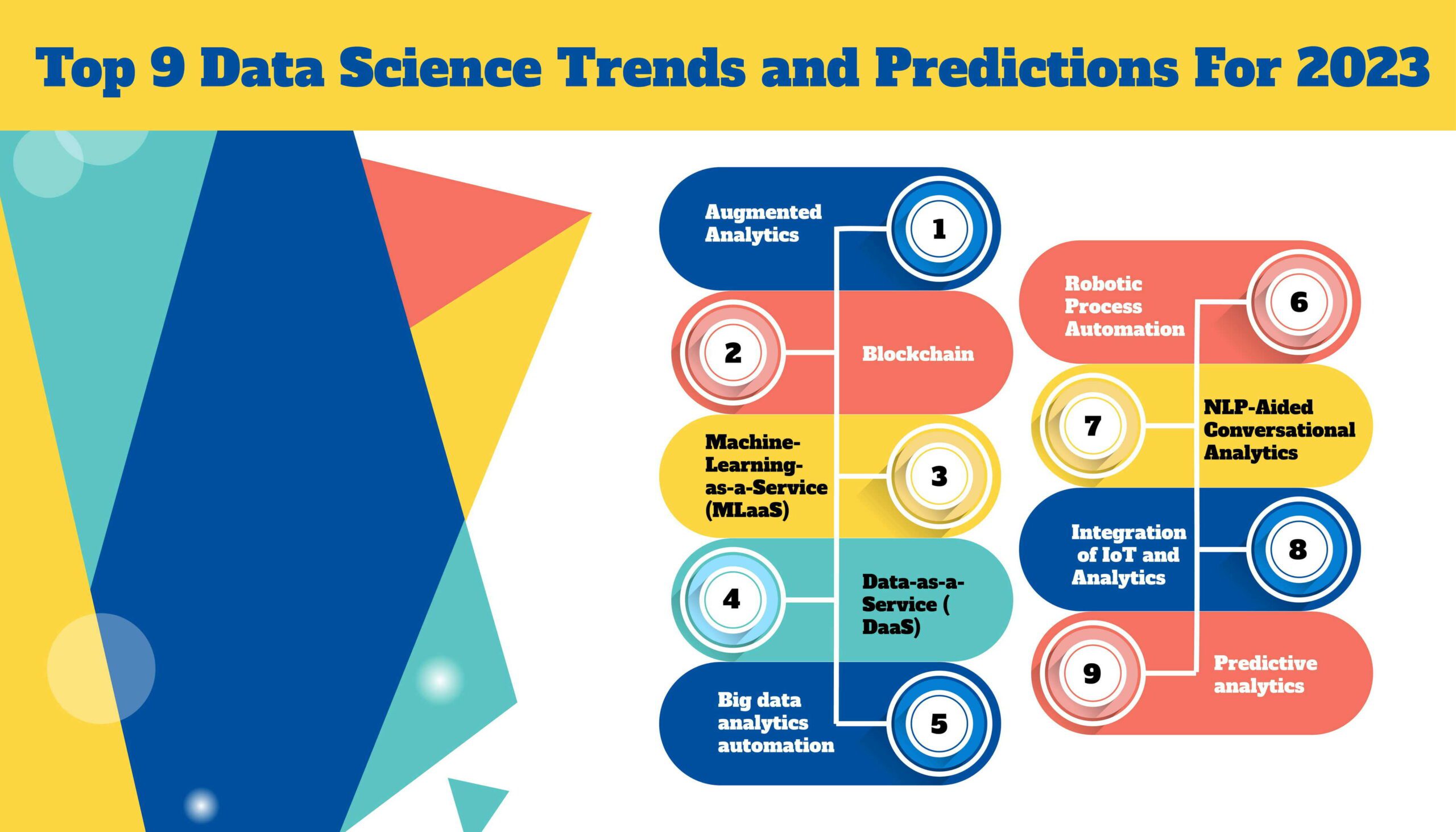
- Augmented Analytics
- Blockchain
- Machine-Learning-as-a-Service (MLaaS)
- Data-as-a-Service (DaaS)
- Big data analytics automation
- Robotic Process Automation
- NLP-Aided Conversational Analytics
- Integration of IoT and Analytics
- Predictive analytics
Why Businesses Are Investing in Data Science for Security
Key Investment Drivers
| Driver | Impact |
| Rising cost of breaches | Average data breach cost reached $4.88 million in 2024 (IBM) |
| Regulatory pressure | GDPR, DORA, NIS2 impose fines up to 2% of global revenue. Organizations increasingly rely on the role of a Data Protection Officer (DPO) to navigate compliance requirements. |
| Insurance requirements | Cyber insurers now require evidence of AI-powered security controls |
| Talent shortage | Automation extends the reach of existing security teams |
| Attack sophistication | AI-powered attacks require AI-powered defenses |
Three Reasons Businesses Utilize Data Science
- More effectively delivering goods and services: Big data refers to data sets so enormous and diverse that conventional methods can’t produce actionable insights. Data science unlocks this potential.
- Knowledge extraction: Data science enables practical, actionable insights by extracting knowledge from raw data. Calculating and monitoring these metrics enhances efficiency, mitigates risks, improves user experiences, and makes operations more agile.
- Automating routine processes: Data scientists make technical workflows more accessible with AI and machine learning. A machine learning algorithm can automate decision-making for pricing, cost structure, loan decisions, and risk assessment.
Four Reasons Cybersecurity Is Crucial for Businesses
- The cost of breaches is on the rise: According to Cybersecurity Ventures, cybercrime was projected to cost the globe $6.2 trillion annually by 2021. By 2026, that figure exceeds $10 trillion.
- Reputational damage: A data breach wreaks havoc on finances and damages reputation. Firms must follow best practices to prevent losing confidential information.
- Advanced cyberattacks: Attackers target IT networks using known security flaws. The availability of hacking tools has resulted in a significant increase in successful breaches.
- Proliferation of IoT devices: Active and connected IoT devices rose from 11 billion in 2020 to over 23 billion by 2025. Companies are increasingly aware of the risks these connected devices pose.
Conclusion
Data science has fundamentally transformed cybersecurity from a reactive, rule-based discipline into a proactive, intelligence-driven field. Machine learning algorithms now detect threats that no human analyst could identify alone.
AI-powered automation frees security professionals to focus on strategic initiatives. And emerging technologies like Agentic AI and post-quantum cryptography are reshaping the landscape for the next decade.
The message from industry leaders is clear: cybersecurity is now a data game. The organizations that thrive will be those that embrace data science not as a standalone tool, but as an integral part of their security strategy.
For professionals, this convergence represents one of the most significant career opportunities in technology today.
Frequently Asked Questions
What programming languages are used in cybersecurity data science?
Python is the dominant language, followed by R and SQL. Python libraries like Pandas, Scikit-learn, and TensorFlow are industry standards for security analytics. Many roles also require familiarity with Bash scripting and SQL for log analysis.
What industries hire the most security data scientists
Financial services, healthcare, technology, government/defense, and managed security service providers (MSSPs) are the top hirers. Almost any organization with a mature security program now employs data science capabilities.
Can data science prevent all cyberattacks?
No. No single technology can prevent all attacks. Data science significantly reduces risk by enabling faster detection, automated response, and predictive threat intelligence but a defense-in-depth strategy combining people, processes, and technology remains essential.