90% of cyber professionals consider Zero Trust essential, yet only 10% of organizations have achieved advanced cyber resilience through its implementation. This gap reveals both the critical importance and complex reality of this modern security paradigm.
The digital perimeter has vanished. With cloud services, remote workforces, and sophisticated cyber threats, the traditional castle-and-moat approach to security where everything inside the network is trusted, has become dangerously obsolete. In response, a new paradigm emerged: Zero Trust Security.
Coined by analyst John Kindervag in 2010, Zero Trust is not a single product, but a strategic framework built on the foundational principle of “never trust, always verify”.
This guide provides a comprehensive overview of Zero Trust principles, architectural models, practical implementation steps, and the tools needed to build a more secure and resilient organization.
The Core Principles of Zero Trust: A New Security Mindset
Zero Trust represents a fundamental shift in cybersecurity philosophy. It moves away from location-based trust, where simply being “inside” the corporate network grants access, to a model of continuous, identity-centric verification. This shift is operationalized through several key principles.
Verify Explicitly: Every access request, whether from a user, device, or application, must be authenticated and authorized based on multiple contextual factors. This includes user identity, device health, location, time of request, and data sensitivity.
Assume Breach: Operate under the assumption that the network is already compromised. This mindset prioritizes containment strategies, ensuring that if an attacker gains access to one resource, they cannot freely move laterally to others.
Enforce Least Privilege: Users and systems are granted the minimum access necessary to perform their tasks, for only the required duration. This minimizes the “blast radius” of any potential breach.
Continuously Monitor: Trust is not a one-time decision. Security policies are enforced and re-evaluated in real-time based on changing context and behavior analytics, enabling proactive threat detection and response.
Architecting Zero Trust: Key Frameworks and Models
Zero Trust is a philosophy, but Zero Trust Architecture (ZTA) is its tangible implementation. Major cybersecurity authorities have developed frameworks to guide this complex process.
NIST Zero Trust Architecture (SP 800-207): This foundational standard defines the logical components of ZTA. It describes three key elements: a Policy Engine that makes access decisions, a Policy Administrator that executes them, and a Policy Enforcement Point that enables the connection.
NIST outlines several implementation approaches, including Enhanced Identity Governance, Microsegmentation, and Network Infrastructure overlays.
DoD Zero Trust Reference Architecture: Designed by the NSA and DISA, this robust framework is built on seven pillars:
User, Device, Applications & Workloads, Data, Network & Environment, Automation & Orchestration, and Visibility & Analytics. It provides a detailed blueprint for securing highly sensitive environments.
CISA Zero Trust Maturity Model: This model offers a practical, phased roadmap for organizations at any starting point.
It structures the Zero Trust journey across five pillars namely Identity, Devices, Networks, Applications, and Data, which are guiding organizations from Traditional to Optimal maturity levels.
Implementing Zero Trust: A Phased Action Plan
Transitioning to a Zero Trust model is a journey, not a one-time project. A successful implementation requires careful planning and a phased approach to manage complexity and resources.
The following roadmap outlines the key stages of a Zero Trust implementation
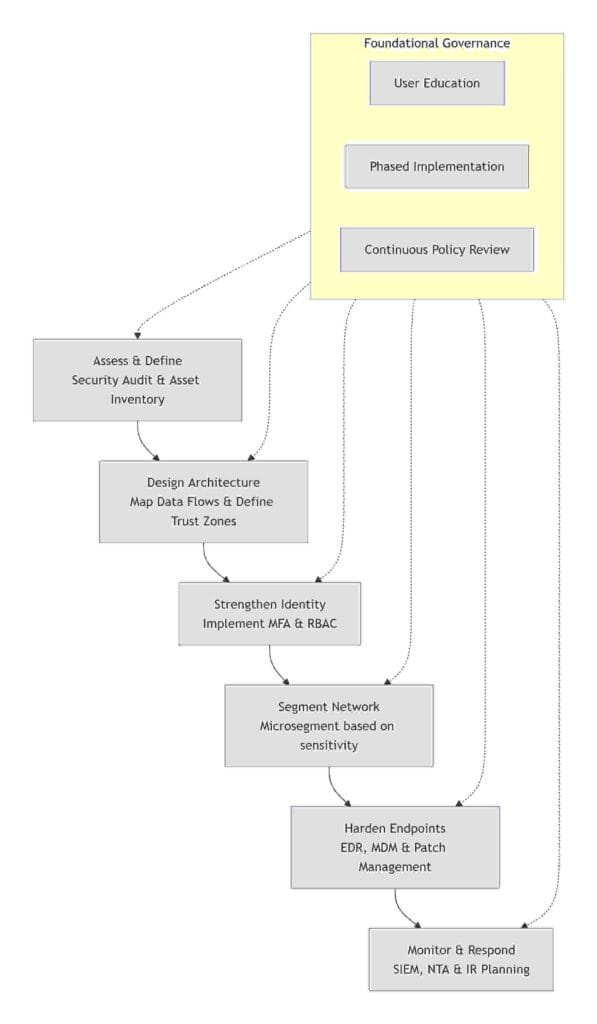
Assess and Define
Conduct a Security Audit: Catalog all users, devices, applications, and data flows. Tools like network scanners can help establish a baseline.
Identify Critical Assets: Determine your “protect surface”—the most sensitive data, applications, and services that warrant the highest level of protection.
Strengthen Identity and Access
Deploy Multi-Factor Authentication (MFA): MFA should be mandatory for accessing any sensitive resource, significantly reducing the risk of stolen credentials.
Enforce Least Privilege via RBAC: Implement Role-Based Access Control (RBAC) to ensure users only have access to what they need. Consider Just-in-Time (JIT) access for highly privileged tasks.
Segment the Network
Implement Microsegmentation: Move beyond basic VLANs to create granular, isolated segments around specific workloads or data types. This is critical for containing breaches and preventing lateral movement. Tools like VMware NSX or Cisco Secure Workload can facilitate this.
Harden Endpoints and Monitor
Ensure Endpoint Compliance: Use Endpoint Detection and Response (EDR) and Mobile Device Management (MDM) solutions to verify device health before granting access.
Enable Continuous Monitoring: Aggregate logs with a Security Information and Event Management (SIEM) system and deploy behavioral analytics to detect anomalous activity in real-time.
Key Technologies and Tools for a Zero Trust Architecture
Building a ZTA requires a suite of integrated technologies. Below is a summary of essential tool categories and specific examples that address different Zero Trust needs.
| Component | Purpose | Example Tools & Solutions |
| Identity & Access | Verify user identity and enforce the least privilege. | Okta, Microsoft Azure AD, Ping Identity, CyberArk (for privileged access) |
| Network Segmentation | Isolate workloads and prevent lateral movement. | VMware NSX, Illumio, Cisco Secure Workload, Zscaler Private Access |
| Endpoint Security | Ensure device health and compliance before granting access. | CrowdStrike Falcon, Microsoft Defender for Endpoint, Microsoft Intune |
| Visibility & Analytics | Continuously monitor activity and detect anomalies. | Splunk SIEM, IBM Anomaly Detection, Darktrace |
| Data Security | Protect sensitive data through encryption and control. | Forcepoint DLP, Microsoft Purview, Symantec DLP |
| Secure Access | Replace legacy VPNs with context-aware gateways. | Pomerium, Tailscale, Zscaler Zero Trust Exchange |
Real-World Applications: Zero Trust Across Industries
The versatility of the Zero Trust model makes it applicable across sectors, particularly those handling sensitive data.
Healthcare
Protects electronic health records (EHRs) by ensuring only authorized medical staff can access patient data, with strict audit trails and continuous monitoring for unusual access patterns.
Financial Services
Secures customer financial data and transaction systems by implementing strict access controls and JIT privileges for administrators, helping to meet stringent compliance regulations.
Government
Safeguards classified information and critical infrastructure by applying the DoD’s rigorous Zero Trust pillars, ensuring that access is granted based on a “need-to-know” basis under continuous evaluation.
Retail and Technology
Mitigates insider threats and protects intellectual property by segmenting development environments, securing cloud workloads, and controlling third-party vendor access.
Challenges and Considerations for Implementation
While the benefits are clear, organizations must navigate significant challenges when adopting Zero Trust.
Implementation Complexity and Cost
Integrating new technologies with legacy systems can be complex and resource-intensive. A phased, prioritized approach is essential to manage cost and disruption.
User Experience
Frequent authentication prompts can frustrate users. Balancing security with usability through risk-based adaptive authentication and user-friendly MFA methods is critical for adoption.
Operational Burden
Zero Trust generates vast amounts of security telemetry. Organizations must ensure they have the tools and expertise to manage, monitor, and act on this data effectively.
Cultural Shift
Moving from a perimeter-based model requires a change in mindset for both security teams and end-users. Executive sponsorship and ongoing education are key to driving this cultural transformation.
Moving Forward with Zero Trust
The evolution toward Zero Trust is no longer optional; it is a necessity for modern cyber resilience. As noted by authoritative sources, the traditional network perimeter is gone, and security must be dynamic, identity-aware, and continuous.
Begin your journey by assessing your most critical assets and highest risks. Leverage established frameworks from NIST, CISA, or the DoD to create a tailored roadmap. Start with foundational steps like enforcing MFA and segmenting a critical network segment, then gradually expand.
Remember, Zero Trust is not a destination but an ongoing process of adaptation and improvement. By embracing its principles, organizations can build a robust defense-in-depth strategy that significantly reduces risk in today’s borderless digital world.